

Learn how to stop yelling at your kids by finding your real triggers, using calming techniques that hold up in the moment, and repairing the connection afterward. Written by a Board Certified Holistic Health Practitioner and mom of three who has lived every word of this. Don’t forget the 3 Book Reset: The Calm Mom Kit to put it all into action NOW.

I Was Becoming a Mom I Didn’t Recognize
Bedtime at my house used to be a circus act, minus the fun.
I’d tuck the kids in, kiss them goodnight, and head downstairs to collapse on the couch. Five minutes later: giggles. Footsteps. A door creaking open. Back up the stairs I’d go. Again. And again. By the fourth trip, my patience would snap like a rubber band pulled too far, and before I realized what was happening, I was yelling.
The aftermath was always the same. Guilt. Tears, often my own. And that sinking, heavy feeling of being the angry mom I swore I’d never be.
If you’ve ever caught a glimpse of yourself in the mirror after a yelling spell and barely recognized the person staring back, I know. I’ve been there. And the truth I want you to hear right up front, before we go any further, is this: wanting to stop yelling doesn’t make you a bad mom. It makes you a mom who’s paying attention.
This post walks through what actually works: the triggers behind yelling, calming techniques you can use in the heat of the moment, and how to repair with your kids when (not if) you slip up.
How to Stop Yelling at Your Kids, in Short
If you’re standing in your kitchen right now and just need the quick version, here it is:
- Find your real triggers, not just the surface ones.
- Use in-the-moment calming strategies like pausing, whispering, and naming the feeling out loud.
- Get curious about what’s underneath the moment, for your child and for you.
- Loosen your grip on control and trade power struggles for choices.
- Set clear expectations and use logical consequences so you’re not enforcing rules in the heat of the moment.
The rest of this guide unpacks each one, plus how to repair afterward. Because repair is the part that actually rebuilds trust.
Why Do Parents Yell at Their Kids?
Here’s something that took me years to figure out: yelling usually isn’t about the kids at all. It’s about us.
Stress piles up. The house is a mess. There’s a work deadline looming, a text you forgot to answer, dinner that needs making, laundry that multiplies overnight like it’s in a horror movie. Then one more sibling fight, one more “I don’t want to,” one more spilled juice box, and the pressure cooker pops.
In my own house, I can trace almost every yelling moment back to one of these triggers:
- Feeling overwhelmed or out of control
- Kids not listening or pushing limits (especially at the same time every day)
- Noise and chaos during the stressful transition points: mornings before school, the witching hour before dinner, bedtime
- Carrying habits from my own childhood, where yelling was the default setting
- Being physically depleted: hungry, tired, dehydrated, hormonal, or just plain worn out
That last one is the sneakiest. We can’t pour from an empty cup, and most moms I know are running on about a quarter tank by 3 p.m.
Here’s the reframe that changed everything for me: the yell isn’t the problem. It’s the smoke alarm. The actual fire is the pattern underneath, the same trigger firing at the same time about the same thing, week after week. Once you can see the pattern, you can finally get ahead of it instead of apologizing for it on repeat.
The Childhood Pattern I Didn’t Want to Repeat
I grew up in a house where yelling was the communication style.
The hours before and after school were tense. My siblings and I walked on eggshells, trying not to disrupt the peace, trying to stay in line and not set off our parents’ tempers. They spent most of their time yelling at each other, but we were often caught in the crossfire when they needed a different target. When your parents yell daily, you become scared to do anything out of line. You shrink yourself.
So when I caught myself yelling at my own children, the same kids I am madly, ridiculously in love with, something cracked open in me. I realized I was recreating the exact childhood I’d spent years promising I would never give my own kids.
That was the moment I decided to become a different kind of mom. Not a perfect one. A different one.
Is Yelling at Your Kids Actually Harmful?
Research on yelling is pretty clear, and it’s worth knowing, not to make you feel worse, but because understanding the real impact can be the thing that finally gets us to change. Frequent yelling doesn’t motivate kids to listen better. It tends to cause:
- Increased anxiety and fear. Kids become hyper-vigilant, always scanning your mood.
- Disconnection. They stop coming to you when they’re upset, because your reaction feels unsafe.
- Modeling. They learn that yelling is how grown-ups handle hard feelings, and they do the same.
- Shame spirals. Especially when the yelling is about them, not just a behavior.
What kids actually need in those hard moments isn’t a louder voice. It’s guidance, structure, and almost always, connection.
Here’s the good news I want you to hold onto: kids are resilient, and relationships are repairable. Occasional yelling in an otherwise warm, responsive home is not the same as a chronic yelling environment. You do not have to be a perfect parent to raise a secure child. You just have to be a parent who’s willing to grow.
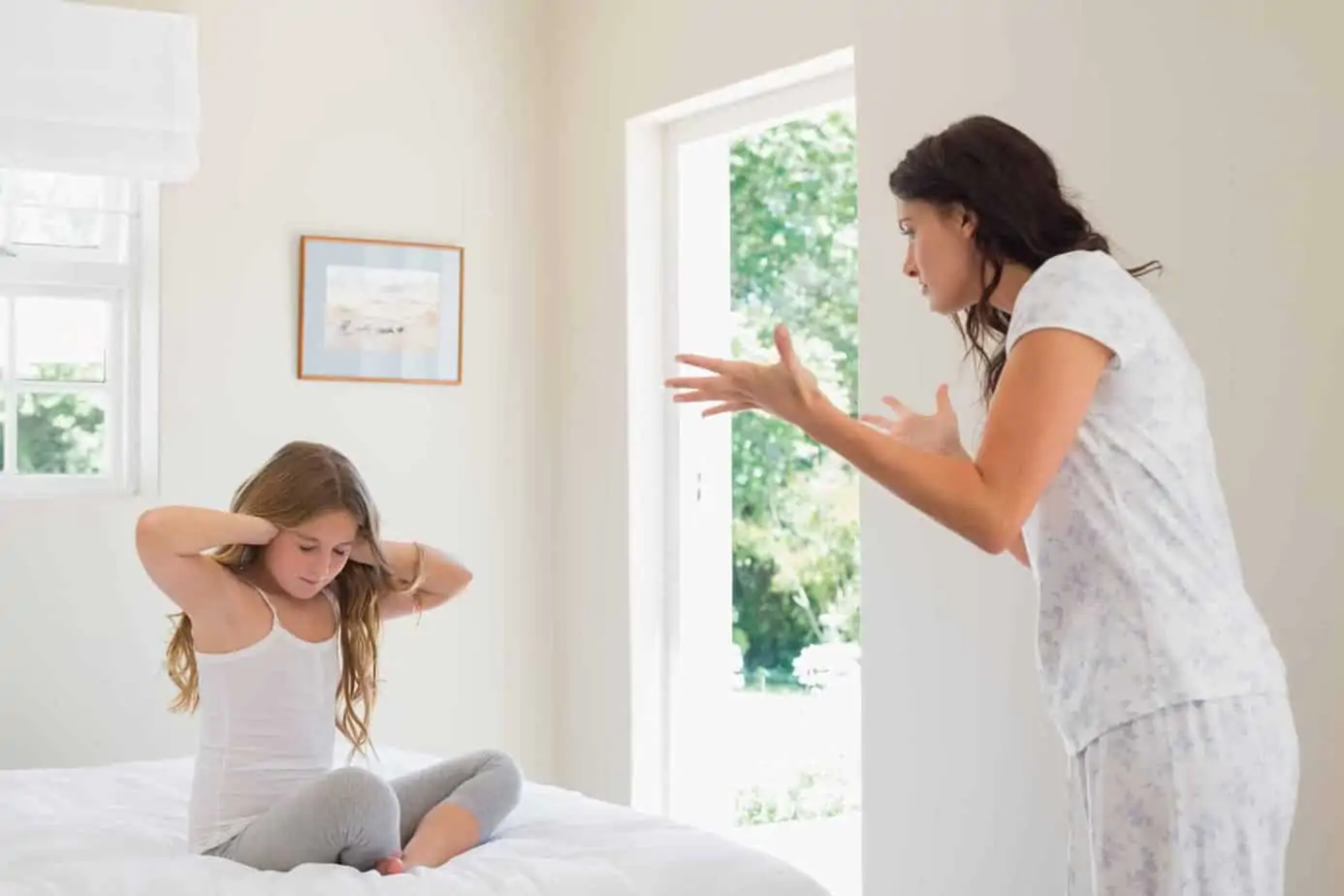
How to Stop Yelling at Your Kids: 5 Shifts That Actually Work
These aren’t theoretical tips. These are the shifts that got me out of the yelling spiral and keep me out of it on most days. (Not all days. I’m still a human with a pulse.)
1. Find Your Real Triggers (Not the Surface Ones)
The first step is knowing what actually sets you off. And I mean really sets you off, not just the obvious thing in the moment.
Spend a few days being a detective on yourself. When you feel that familiar heat rising in your chest, pause and notice:
- When are you most likely to yell? What time of day? What day of the week?
- What’s happening around you? Noise level, time pressure, clutter, multiple kids needing you at once?
- What’s happening inside you? Are you hungry? Tired? Touched-out? Carrying stress from something unrelated to the kids?
Write it down. Even a quick note in your phone. You’ll start to see patterns, and patterns are powerful, because once you can name the pattern, you can get ahead of it.
For me, my main triggers are work deadlines, my messy house, and the moment the noise level in our home crosses into sonic territory. Once I named those three things, I could start building actual solutions: closing my laptop an hour earlier, giving myself permission to leave the living room messy until bedtime, and putting on quiet music when the chaos starts building.
Your triggers are your roadmap. Don’t skip this step. (If mapping them on your own feels slippery, this is exactly the work in The Trigger Map, a four-week guide to pinning down what’s really setting you off.)
2. Use In-the-Moment Calming Strategies
Once you know your triggers, you need tools for when they show up anyway. Because they will.
When I feel the frustration building, that tight chest, the clenched jaw, the voice that’s about to get too loud, I reach for one of these:
- Take a pause. Step into another room, even for 30 seconds. Breathe. Splash cold water on your face. Get fresh air on the porch.
- Say it out loud. “Mommy is feeling really frustrated right now.” Naming the feeling in front of your kids does two things: it helps you regulate yourself, and it shows them exactly how a grown-up handles a big feeling.
- Use a time buffer. “I need five minutes. Please play quietly in your room, and then we’ll figure this out.” Kids can handle five minutes of waiting. You’ll be glad you took them.
- Lower your voice instead of raising it. This one feels counterintuitive, but it’s the single most effective trick I know. Whisper. Every time. Kids lean in to hear a whisper. They tune out a shout.
One of my favorite strategies, and the one that’s built more trust between me and my kids than anything else, is simply being honest with them. I’ll say, “Mommy is feeling frustrated right now that you’re not listening, and I’m about to lose my patience. I’m going to take a break so I don’t yell.”
When my kids hear me acknowledge my feelings out loud, two things happen. They can see I’m trying to stay in control of myself, which teaches them what regulation looks like. And they often take their own step back, because the tension in the room just dropped.
BONUS: 20 Tips to Calm Down When You’re Upset or Angry
3. Get Curious About What’s Going On Underneath
When I’m fighting the urge to yell, I’ve learned to pause and put myself in my child’s shoes for a second. It sounds simple, but it completely shifts the energy.
What’s actually going on with my son right now? Is he tired? Hungry? Did something happen at school he hasn’t told me about? Is he feeling overlooked because his sister has had more of my attention lately? Does he need one-on-one time to reconnect?
Then I turn that same lens on myself. Beyond the surface-level “it’s too loud, I’m hungry, nobody napped,” what’s underneath? Am I anxious about something I haven’t processed? Did I take on too much this week? Am I carrying something from my own childhood into this moment?
This is also where a lot of moms hit the same strange wall: one kid wears you out and the other one barely registers. That’s rarely about the kids being that different. It’s usually about the story they trigger in you. That’s the deeper layer I dig into in The Story She’s Forming, if you find yourself reacting to one child in a way you can’t quite explain.
Getting curious instead of reactive is a skill. It won’t happen overnight, and you won’t remember to do it every time. But the more you practice the pause-and-ask-why, the less often yelling feels like your only option.
4. Loosen Your Grip on Control
This one took me the longest to learn, and I think it’s the most important.
One of the biggest reasons parents yell isn’t because kids are out of control. It’s because we are trying too hard to keep everything perfectly in control. We want the bedtime routine to go smoothly, the homework done without reminders, the house to stay clean, the kids to listen the first time. When reality doesn’t match the picture in our heads, yelling fills the gap.
Here’s the truth I had to sit with: the tighter you grip, the more your kids push back. Control creates power struggles, and power struggles create shouting matches.
The shift isn’t about letting your kids run wild. It’s about moving from controlling to guiding: setting boundaries while giving kids choice and ownership inside those boundaries. When kids feel respected, they cooperate more. Almost every single time.
Try swapping control battles for choice-within-a-boundary:
- Homework: “Your homework needs to be finished tonight. Do you want to start before dinner or after?”
- Chores: “The kitchen needs to be cleaned. Do you want to unload or reload the dishwasher?”
- Bedtime: “It’s lights-out time. Do you want to read for 10 minutes first, or go straight to sleep?”
- Getting out the door: “We’re leaving in 10 minutes. Do you want to put your shoes on now, or in five minutes when the timer goes off?”
You’re still the parent with the final say. You’ve just taken the fight out of the everyday routines. And when the fights decrease, so does the yelling, almost automatically.
5. Set Clear Expectations and Use Logical Consequences
Kids genuinely thrive with structure. When routines and rules are clear before the hard moment, you don’t have to scramble to enforce them in the middle of one.
A few things that work in our house:
- Connect before you correct. A hug, eye contact, or a gentle hand on their shoulder before giving an instruction works better than shouting from the next room.
- Choose logical consequences, not random ones. Instead of yelling, connect the behavior to a related, natural outcome. Toys left out all over the floor means those toys go away for a few days. Phone misused means the phone gets a break. The consequence teaches the lesson; it doesn’t just punish.
- Be boringly consistent. Kids push hardest when they can’t predict what you’ll do. When your response is calm and the same every time, they stop testing the limit nearly as often.

How to Repair After You Yell (Because You Will)
Let’s be honest with each other: you’re going to yell sometimes. You are a human. The important part isn’t pretending it didn’t happen. It’s what you do afterward.
Repairing shows your kids that even parents make mistakes, and that healthy relationships are built on honesty and accountability. It models exactly the behavior you want from them.
When you yell, circle back once you’ve calmed down. Not two seconds later when you’re still shaky, but not two days later either. A simple, age-appropriate apology goes a long way. You don’t need to grovel or over-explain. Just be direct:
- “I’m sorry I yelled earlier. I was feeling really frustrated, and I should have handled that differently.”
- “I didn’t like how I spoke to you. Can we try that again?”
- “That wasn’t okay, and I’m working on it. I love you.”
Then, and this part matters, reconnect. A hug. A shared laugh. Reading a book together. Making a goofy face. Something that reminds your child that your love is steady, even when your tone wasn’t.
When you apologize, it also helps to tell your child why you were angry. Describing your emotions teaches kids to make the connection between feelings and reactions. And it often surprises you what comes up when you really dig:
- Was I frustrated that the kids weren’t listening when I asked them to clean up the playroom, or was I anxious because guests are coming over and the house looks like a tornado hit it?
- Was I angry that the kids were hitting each other, or was I sad that they don’t always get along the way I hoped they would?
- Did I lose my patience because my daughter refused dinner, or because I was worried she’d be hungry at bedtime and I’d have to start all over again?
It’s also okay to ask your kids how it makes them feel when you yell. Give them space to talk about their emotions and describe what they felt in that moment. Their answers will probably break your heart a little, but that’s the information that will keep you motivated to keep growing.
Repairing doesn’t erase the yelling. But it teaches your kids something far more powerful: mistakes don’t end relationships. They can be repaired with humility, honesty, and connection.
If the apology is the piece you keep fumbling, the one that never quite lands no matter how many times you say it, that’s the exact problem After the Yell was written to solve, with a short, repeatable repair you can use in the ten minutes after you lose it.
Stop Yelling. Start Looking. (The Calm Mom Reset)
If everything above is resonating and you want it all in one place, the work in this article lives inside The Three-Book Reset, my $29 Calm Mom Kit.
It’s three short books that map straight onto the three hardest parts of yelling less:
- The Trigger Map helps you find the patterns underneath the snapping, so you can get ahead of them instead of apologizing on repeat.
- The Story She’s Forming uncovers what’s actually running underneath your reactions, especially when one kid wears you out and the other doesn’t.
- After the Yell gives you a simple, honest repair for the nights you already lost it, without groveling or the long apology that never quite lands.
132 pages, 18 printable worksheets, instant PDF download, read them in any order. No theory, no shame, no perfect-parent voice. Just the honest work.
Get The Three-Book Reset for $29 →
A Gentle Word of Encouragement
Learning to stop yelling is slow work. It’s not a switch you flip. It’s a thousand small choices you make across a thousand small moments.
Some days you’ll nail it. You’ll use the pause, you’ll whisper instead of shout, you’ll repair beautifully afterward, and you’ll feel like a freaking parenting wizard.
Other days, you’ll yell at the top of your lungs because someone spilled juice on the couch for the third time this week, and you’ll feel awful about it. Both days are part of the process. Both days are okay.
With awareness, calming techniques, logical consequences, and a willingness to repair, you can create a calmer, more connected home. The goal isn’t perfection. It’s always progress.
Your kids don’t need a flawless mom. They need one who’s present, patient when she can be, and willing to grow right alongside them.
FAQs About Yelling and Parenting
These are some of the most common questions I get from parents in my practice when it comes to yelling, with honest answers from someone who’s been on both sides of them.
Why do I yell at my kids so much?
Yelling almost always comes from stress, overwhelm, depletion, or patterns you grew up with. Most of the time it isn’t really about the kid or the moment. It’s the final straw on top of everything else you’re carrying. Identifying your true triggers is the first real step to stopping.
Is it normal to yell at your kids?
Yes. Almost every parent yells at some point, and one yelling moment does not undo a loving relationship. What matters far more than whether you ever yell is how often it happens and whether you repair afterward. An occasional slip in a warm, responsive home is very different from a constant yelling environment.
Is yelling at my kids actually damaging?
Frequent yelling can lead to anxiety, fear, and disconnection in kids, and they often start to model the behavior themselves. The good news: occasional yelling in an otherwise warm, responsive home is not the same as a chronic yelling environment. Repairing through apology, connection, and consistency restores trust.
What can I do instead of yelling at my kids?
Try calming techniques like pausing, whispering instead of shouting, naming your feelings out loud, offering choices within a boundary, and applying logical consequences. Here’s a great grounding tool that works for moms and kids.
How do I stop yelling when I’m already angry?
In the moment, your body is in fight-or-flight, so you can’t reason your way out of it. The fastest exit is a physical one: leave the room, splash cold water on your face, take 10 deep breaths, or say out loud, “I need a minute.” You’re not abandoning your kids by stepping away for 60 seconds. You’re modeling self-regulation.
How do I stop yelling at my toddler?
With toddlers, prevention does most of the work, because they can’t yet reason or wait the way older kids can. Keep routines predictable, narrow their choices to two good options, and watch for the hunger-and-tired window when meltdowns spike. When you feel yourself escalating, get down to their eye level and lower your voice instead of raising it. Toddlers co-regulate off your nervous system, so a calmer you is the fastest way to a calmer them.
How do I repair after I’ve yelled?
Wait until you’re truly calm, then go to your child, get down on their level, and keep it simple: “I’m sorry I yelled. I was feeling frustrated, overwhelmed, or tired, and that wasn’t okay. I love you.” Follow it with a hug or a small reconnection. You do not need to grovel or perform. Short, honest, and warm is what kids remember.
Will my kids forgive me for yelling?
In an overwhelmingly loving home, yes. Kids are remarkably forgiving when they feel fundamentally safe and loved. What builds trust over time is not the absence of mistakes. It’s the consistent presence of repair.
Related Articles for Moms, Parenting, and Yelling Less
- 10 Effective Habits of a Happy Stay at Home Mom
- 10 Tips to Help You Become a More Patient Parent
- How to Stay Calm When Your Child Misbehaves
- 25 Things That Are Stealing the Joy of Motherhood
- Mom Burnout Symptoms and Recovery
Want even more?
Shop All Parenting Resources
Shop all of our parenting resources from self-regulation tools and managing big emotions to building self esteem and confidence. There are resources for all seasons of life!






I 100% LOVE THIS!!! Thank you so much!
Of course, so glad you found it useful Carolyn.
I needed to read this so bad. Thank you!
I was also raised in a household where both my parents would yell. I do not want to do that to my children so I’m going to remember that quote
I am a yelling mom. So true kids are just being kids. I am working on it. Great tips!