Simple grounding techniques for kids to calm the racing “monkey mind” and find relief from anxiety and big worries — 5 grounding exercises you can teach today. Plus, how picture routine cards can give kids confidence and calm down picture cards can help them self-regulate when anxiety or big emotions strike.

The Moment I Realized My Daughter’s “Tummy Aches” Were Actually Anxiety
It started small — the kind of thing every parent brushes off at first.
My daughter began saying her stomach hurt before school. Then before soccer practice. Then before bedtime. At first I thought it was something physical — maybe she’d eaten too fast or caught a little bug. But after the third week of “tummy aches” that always showed up right before big events, I started to see it for what it was: anxiety.
One night, I found her sitting cross-legged on her bed, clutching her stuffed animal with tears in her eyes. “I just can’t stop thinking about it,” she said quietly. “What if I mess up? What if I forget what to say? What if everyone laughs?”
My heart broke a little. Because I knew that feeling.
That night, instead of trying to fix it or tell her not to worry, I sat beside her and said, “Let’s help your body feel safe again.”
That’s when I started teaching her grounding techniques — simple, science-backed ways to bring her mind and body back into the present moment. Over time, she learned that while she couldn’t always stop anxiety from showing up, she could stop it from taking over.
And that’s what I want to help you teach your child, too.
The quick version: Grounding techniques calm anxiety by pulling a child’s attention out of anxious thoughts and back to their body and surroundings. The most effective ones — like the 5-4-3-2-1 senses exercise and slow belly breathing — are simple enough for a preschooler and work for teens and parents too. The one rule most people miss: practice them when your child is calm, not only in the middle of a meltdown. That’s what makes them work when it counts.
Why Childhood Anxiety Is So Common (and Nothing to Be Ashamed Of)
Anxiety is a tricky thing. The body’s “fight or flight” response gets activated, and when it’s switched on too often, the body can start to feel dysregulated and on-edge much of the time.
New or big experiences — starting school, moving, the loss of a friend or family member, problems at home, divorce, shifting friendships — often stir up anxious feelings. Those feelings can show up as changes in behavior, mood, eating, or sleep, or as new fears, worries, and shyness. Any change in our kids worries us as parents, but anxiety is often the overlooked cause underneath the behavior.
And it’s far more common than most parents realize. According to the Anxiety and Depression Association of America (ADAA), anxiety disorders are among the most common mental health conditions affecting children and teens — and rates have been rising. The encouraging news: childhood anxiety is also highly treatable, and the earlier kids learn coping tools, the better they tend to do.
Helping your child name what they’re feeling, get curious about the root of it, and recognize the early signs of their own anxiety is the first step — and then you can give them the 5 grounding techniques below.
Why Grounding Works
When anxiety strikes, kids’ thoughts rush ahead to everything that might go wrong. The brain sends danger signals, the body floods with adrenaline, and suddenly even small worries feel enormous.
Grounding is a bridge between the mind and body. It interrupts those racing thoughts and reminds the nervous system that it’s safe right now. As experts at Sanford Health explain, grounding works by bringing a child’s attention out of anxious thought patterns and back to what’s actually happening in their body and surroundings — and practicing it regularly can even strengthen the parts of the brain responsible for calming stress hormones and thinking clearly.
These five grounding techniques are simple enough for a preschooler but powerful enough to help teens — and parents — too.
(There’s a free printable of the 5-Step Grounding Technique you can download below to use with your child or in the classroom.)

The one rule most parents miss: practice when calm.
Here’s the thing nobody told me at first. You can’t teach a brand-new skill in the middle of a panic — that’s like trying to learn to swim while you’re drowning. Grounding only becomes reliable through repetition before it’s needed. Practice these for two minutes after breakfast, or as part of the bedtime routine, when your child is relaxed and happy. That way, when the big feelings hit, their body already knows the path back to calm. The repetition is what turns these from “nice ideas” into tools your child can actually reach for.
5 Grounding Techniques for Kids (and Adults) That Actually Work
I learned from my own therapist that anxiety is rooted in worry and fear about things that haven’t happened yet. The fastest way to get relief is to come back to the present moment — and grounding is how you do it. I use these same techniques as an adult, and they work just as well for kids.
Tip: A Calm Down Toolkit helps kids discover the self-regulation strategies that work best for them, including mindful breathing and pattern tracing.
1. The 5-4-3-2-1 Technique
This is one of the fastest ways to pull an anxious child back from spiraling thoughts. It engages the senses, helping the brain focus on what’s real instead of what’s scary. It’s especially helpful when your child says, “I can’t stop thinking about it,” or “My brain won’t turn off.”
It’s also genuinely backed by research — in one study, the share of participants reporting high anxiety dropped dramatically after practicing the five-senses method.
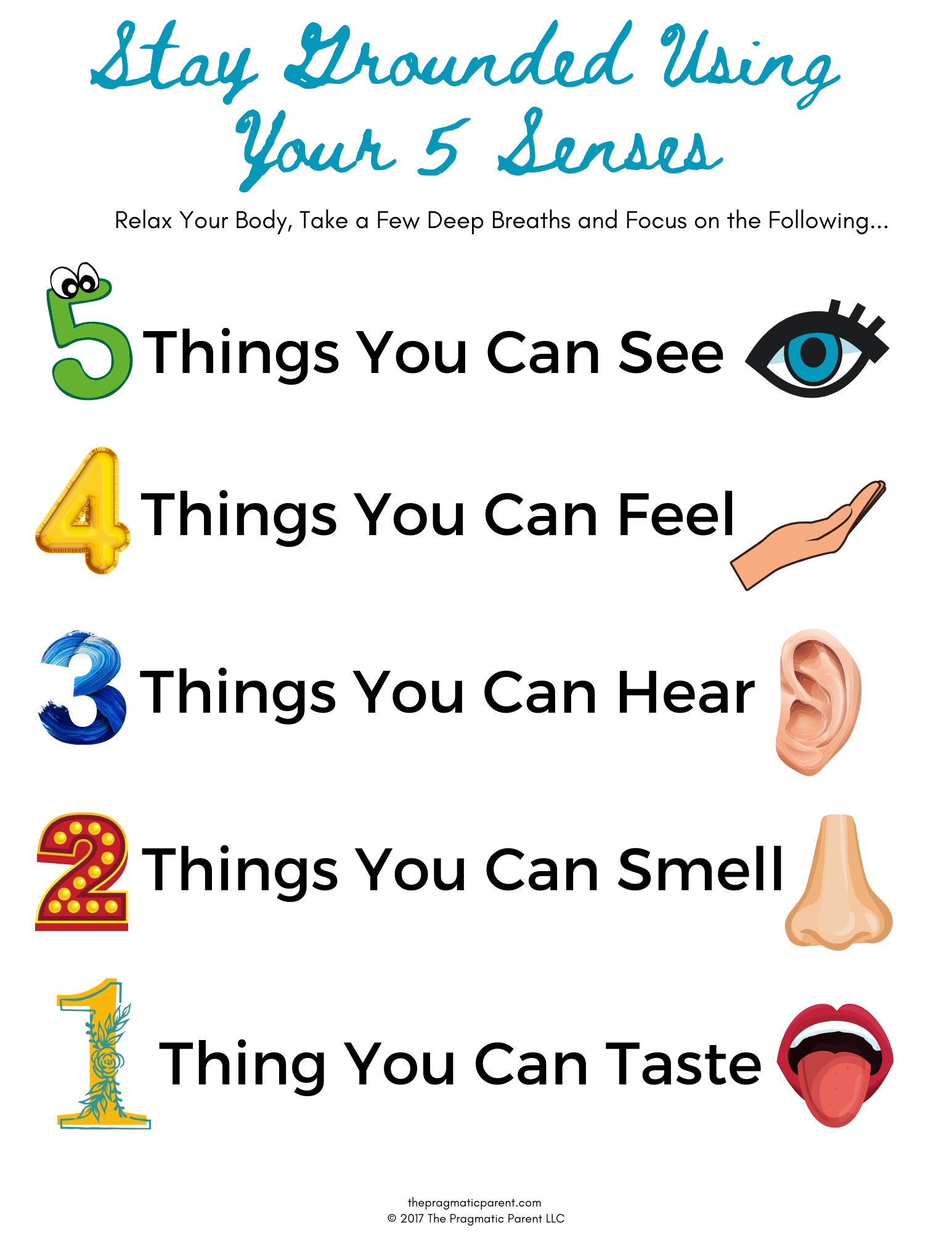
Try this together — name:
- 5 things you can see
- 4 things you can touch
- 3 things you can hear
- 2 things you can smell
- 1 thing you can taste
Real-life example: Before big tests, my son uses this trick right at his desk — he counts colors around the room, listens for the smallest sounds, and quietly reminds himself, “I’m safe. I’m here.”
It’s mindfulness disguised as a game, and it works wonders. To make it playful, turn it into “I Spy,” or ask your child to find five red things in the room. A calm down corner is a great low-sensory spot where your child can use these techniques and feel safe and less stimulated.
Get Your Printable: 5 Grounding Techniques for Kids to Calm Anxiety & Worries (click on the picture or download by using this link here.)
What You’ll Receive:
- An 8.5 x 11″ letter-sized printable
- A PDF you can download in Preview or Adobe (or save to your phone)
- Printable in full-color or black-and-white — hang it wherever your child will see it, at home, in your practice, or in the classroom
2. Grounding With Movement
When kids feel anxious, their body stores that tension like static electricity. Movement gives it somewhere to go. Physical grounding resets the nervous system, helps release built-up stress, and gets the body and brain working together again. It’s a great go-to if your child is fidgety, irritable, or right on the edge of a meltdown.
Try this:
- Stomp your feet like you’re squishing grapes.
- Do slow jumping jacks or big arm circles.
- March around the living room or stretch like a cat.
- Go outside and walk barefoot in the grass — nature grounding at its best.
Why it helps: Rhythmic, whole-body movement is one of the most reliable ways to discharge nervous energy and signal safety to the body — and gentle, slow movement like yoga is among the most well-supported grounding activities for kids.
3. The “Magic Object” Technique
For many kids, having something to hold gives their anxiety somewhere to go — a physical way to carry the worry instead of being carried by it. This is especially helpful for younger children who don’t yet have the words for big feelings.
Try this: Give your child a small, soothing object — a smooth stone, a charm, a stress ball, or a worry stone. When they start to feel overwhelmed, have them hold or rub it while taking slow breaths.
Real-life story: My daughter kept a tiny heart-shaped rock in her pocket. Before school or during tests, she’d squeeze it and breathe. That little rock became her reminder that calm was something she could create, not something she had to wait for.
4. Breathing to Calm the Body
When kids are anxious, they tend to breathe shallowly from the chest, which tells their body, “We’re in danger.” Teaching them to breathe slowly and deeply from the belly sends the opposite message: we’re safe. Breathing is free, invisible, and available anywhere — which makes it one of the most empowering grounding tools there is.
Try this:
- Inhale slowly through the nose for 4 counts.
- Hold gently for 4 counts.
- Exhale through the mouth for 6 counts.
- Repeat 3-5 times.
Make it kid-friendly: Use the “smell the flower, blow out the candle” trick. Younger kids love it, and it gives them a concrete picture to follow. For wiggly little ones, have them blow real bubbles — slow exhales are the whole point, and bubbles make it automatic.
5. Grounding With Temperature
This one works fast because cold sensations activate the vagus nerve — the body’s built-in calming switch. A quick burst of cold triggers a natural reset that slows a racing heart and pulls focus out of the panic spiral and back into the present moment. It’s one of the quickest ways to interrupt panic when it’s escalating.
Try this:
- Splash cool water on your child’s face or wrists.
- Hold a cold pack, a cold drink, or an ice cube for a few seconds to reset the nervous system.
- Step outside for a few deep gulps of cool, fresh air.
- Wrap up in a cozy blanket afterward and take slow breaths together as the body settles.
Real-life example: One mom I worked with said her anxious 9-year-old now asks, “Can I splash some cold water?” when he feels panic start to build. That tiny ritual became his way of saying, I know what to do now.
And that confidence — knowing they can help themselves feel calm — is the real goal.
Bonus: Everyday Habits That Support a Calmer Nervous System
Grounding works best when it sits on top of a foundation of good sleep, regular meals, and steady routines. None of this is about perfection — it’s about giving your child’s body the basic support it needs to regulate emotions more easily.
- Offer balanced meals and snacks with protein, so blood sugar (and mood) stays steadier through the day.
- Prioritize hydration and consistent sleep — both have a big impact on how reactive the nervous system is.
- Keep predictable routines where you can; predictability is calming for anxious kids.
- Model calm yourself. When you’re stressed, name it out loud and show your child what you do about it.
When your child’s body feels rested and nourished, their mind finds calm more easily — because emotional steadiness and physical steadiness go hand in hand.
Signs of Anxiety in Children
Here are three areas to watch when it comes to anxiety — emotional, behavioral, and physical signs — informed by experts at the UCLA Child Anxiety Resilience Education and Supports (CARES) Center.

Emotional Signs of Anxiety in Children
- More sensitive or hypersensitive than usual
- Crying more often than typical
- Reactive, grouchy, or angry without a clear reason
- Afraid to take chances or act, for fear of making even small mistakes
- Extremely anxious before or during tests, sports, or performances
- Panic attacks, or fear of having them
- Worrying about far-off future events
- Phobias and exaggerated fears
- Clinginess and strong worry around drop-offs
- Nightmares about losing a parent or close person
- Worries that pull their attention away from activities and school
- Obsessive thoughts or actions
- Frequent meltdowns or tantrums
Check out the emotions identification toolkit to help kids explore what’s going on under the surface and feel confident putting words to it.
Behavioral Signs of Anxiety in Children
- Constantly asks “What if?” or “What will happen?”
- Avoids participating in activities or class out of fear
- Stays silent or preoccupied during group work
- Makes excuses to avoid school
- Avoids specific activities (PE, sharing, public speaking)
- Stays inside or alone during lunch or recess
- Avoids social situations with peers outside of school
- Becomes emotional or angry when separated from parents
- Constantly seeks approval and reassurance
- Gives up before trying, for fear of failure or embarrassment
Physical Signs of Anxiety in Children
- Frequent headaches or stomachaches
- Refuses to eat at school or in public
- Refuses to use restrooms except at home
- Restless, fidgety, or distracted outside of “safe” places
- Sweating or shaking in new or intimidating situations
- Muscle tension from being constantly on guard
- Frequent night waking
- Trouble falling or staying asleep
Related Article: The Brain Science Behind the Development & Behavior of Children
When to Reach Out for Extra Support
Grounding techniques are wonderful tools, and for everyday worries they’re often enough. But anxiety sometimes needs more than home strategies — and reaching out for help is a sign of strength, not failure.
Consider connecting with your pediatrician or a child psychologist who specializes in anxiety if:
- Anxiety is significantly interfering with school, friendships, or family life
- Your child is having panic attacks or intense physical symptoms
- Worry or avoidance is getting worse over time rather than better
- Your child expresses hopelessness, or you’re ever worried about their safety
A specialist can guide approaches like cognitive behavioral therapy (CBT), which is one of the most effective, well-researched treatments for childhood anxiety. Grounding works beautifully alongside professional support — it doesn’t have to be either/or.
FAQs About Grounding & Anxiety in Kids
What are grounding techniques for kids?
Grounding techniques help kids calm anxiety by reconnecting them to their senses and the present moment. They focus on what a child can see, touch, hear, smell, and feel — helping their body tell their brain, “I’m safe.” Simple methods like the 5-4-3-2-1 exercise, deep breathing, or holding a comfort object work best.
How can I help my child calm down quickly during anxiety?
Start with slow breathing — gentle inhales through the nose, longer exhales through the mouth. Then add a sensory anchor: feet on the floor, a cozy blanket, or naming what they can see and touch. This helps slow racing thoughts and brings the body out of “fight or flight.”
What is the best grounding exercise for anxious kids?
The 5-4-3-2-1 method is the most effective and adaptable for all ages. Kids name five things they see, four they can touch, three they hear, two they smell, and one they taste. It works anywhere — at school, at home, or at bedtime.
At what age can kids start learning grounding techniques?
Even preschoolers can learn simple grounding like deep breathing, holding a “magic rock,” or feeling their feet on the ground. Start with short, visual activities and model calm behavior yourself — kids learn best by watching you regulate first.
Do grounding techniques really work for child anxiety?
Yes. Grounding helps regulate the body’s stress response by slowing breathing, lowering heart rate, and engaging the senses. It gives kids a practical way to manage anxiety instead of being overwhelmed by it — and with regular practice, it becomes second nature.
How can I teach grounding if my child resists calming exercises?
Make it playful. Turn it into a game — pretend to be detectives finding clues (what do you see, hear, feel?), blow bubbles, or walk barefoot outside together. The goal is to make calm feel safe and fun, never forced.
Should I use grounding before or during an anxious moment?
Both — but practicing when your child is calm is what makes it work in the hard moments. Repetition builds muscle memory, so when big emotions hit, their body already knows the way back to calm.
What should I say to my child when they feel anxious?
Keep it simple and validating: “You’re safe right now,” or “Let’s help your body feel calm.” Avoid “Don’t worry” — instead, gently guide them into a grounding exercise. Your calm tone becomes their anchor.
Can grounding techniques help parents too?
Absolutely — and kids actually calm down faster when a parent regulates first. Using grounding for yourself helps you stay composed so you can co-regulate with your child. When you model calm, they learn calm.
Final Thoughts
When your child feels anxious, grounding gives them something powerful — a plan. They might not be able to stop anxious thoughts from appearing, but they can control what happens next. That sense of control is what helps kids shift from fear to confidence.
Anxiety doesn’t mean your child is broken — it means their body and mind are doing their job a little too well. Your role is to help them learn how to turn the volume down, calmly, gently, and consistently. And that’s exactly what these grounding tools do.
Related Resources for Big Emotions, Anxious Kids & Calming Down:
- How Can I Help My Child Deal With Strong Emotions?
- Teaching Feelings & 6 Steps to Help Kids Express Their Emotions
- 7 Ways to Help Kids Identify Feelings & Control Emotions
- 14 Factors That Influence a Child’s Behavior or Trigger Misbehavior
- Tools to Give You Immediate Relief From Parenting Anxiety & Stress
- Ease Your Child’s Back-to-School Anxiety: How to Calm the Jitters
- 6 Positive Parenting Techniques to Use Rather Than Yelling
Want even more?
Shop All Parenting Resources
Shop all of our parenting resources from self-regulation tools and managing big emotions to building self esteem and confidence. There are resources for all seasons of life!